

Under Lights
Fishing At Night is A Prime Time to Land Trophy Snook
By Del Milligan The Ledger
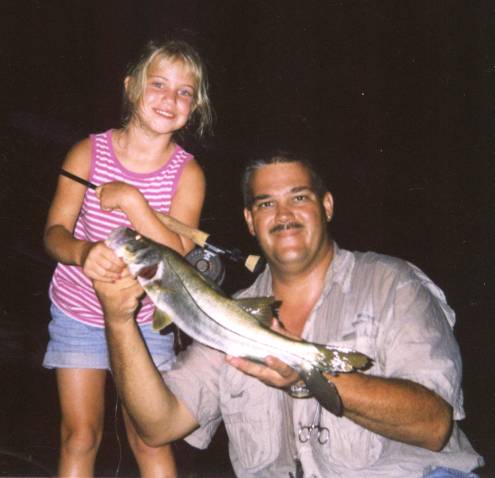 Sight
casting for snook at night under lighted boat docks is opening the curtain on
a picture window into another dimension. When the lights along the Intracoastal
waterways on Florida's west coast from Manatee County to Boca Grande turn on,
dark shadows sudden-ly appear into the light. These lengthy shadows transform
into snook up to 15 and 20 pounds, drawn to the light to snack on glass min-nows
and shrimp like popcorn.
Sight
casting for snook at night under lighted boat docks is opening the curtain on
a picture window into another dimension. When the lights along the Intracoastal
waterways on Florida's west coast from Manatee County to Boca Grande turn on,
dark shadows sudden-ly appear into the light. These lengthy shadows transform
into snook up to 15 and 20 pounds, drawn to the light to snack on glass min-nows
and shrimp like popcorn.
"When clients pull up to a dock with me, their first reac-tion is, 'Oh my God, is that fish?' " said Keiland Smith of Lakeland, a fishing guide who specializes in snook at night on fly rod. Sometimes on summer nights, Smith said, there's as many as 150 snook under one dock. "Almost everybody comes back and says, That's the most fun I've ever had fishing,' " Smith, 35, said. "Daytime, it's a hit-and-miss thing."
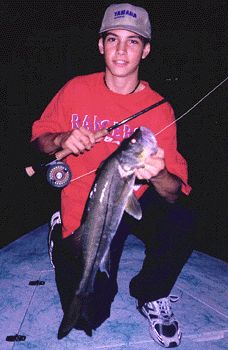 This
licensed charter cap-tain works his 9-to-5 job as an air conditioning technician
at Carpenter's Home Estates in north Lakeland, then travels south two hours to
a favorite fishing spot and keeps his cli-ents casting through the wee hours at
snook they can clearly see. From twilight to twilight can be prime time
for big snook. This is when fly fishermen like Smith prefer to target the wily
snook that hide in the deep shade of the docks as the sun burns its way across
the Flori-da sky.
This
licensed charter cap-tain works his 9-to-5 job as an air conditioning technician
at Carpenter's Home Estates in north Lakeland, then travels south two hours to
a favorite fishing spot and keeps his cli-ents casting through the wee hours at
snook they can clearly see. From twilight to twilight can be prime time
for big snook. This is when fly fishermen like Smith prefer to target the wily
snook that hide in the deep shade of the docks as the sun burns its way across
the Flori-da sky.
"My clients don't get burned up, there's less people on the water, it's a lot cooler and a lot quieter, and it's a lot more peaceful," Smith said. "When everybody's going to bed, I 'm putting my boat in the water." Smith, who runs a Hewes flats boat, has even developed a fly pattern that imitates snack food for the whopper snook that feed without fear around the midnight hour.
Snook can be fussy, so Smith developed a pattern the linesiders have rarely resisted. He calls it the Arctic Snook. It has created quite a following. Andy Thornal's in Winter Haven started selling Smith's flies last week for $4 apiece.
Why has it been so successful? "The flash and the movement," Smith explained. "The way it is designed, it does not strip straight. It darts because of the way I designed it. "Snook hit it when they won't hit anything else. "I've had clients catching fish and turn around and say, 'Do you have any other flies, we haven't used anything else tonight?' Within 15-20 minutes, they go back. It's really comical."
 That's
kind of how Smith created the Arctic Snook. Vacationing in August two summers
ago, Smith became annoyed that 15-pound snook he could see under the night lights
wouldn't take the flies he tried. So he sat down at the kitchen table of the rented
condominium and tied what would become the Arctic Snook pattern.
That's
kind of how Smith created the Arctic Snook. Vacationing in August two summers
ago, Smith became annoyed that 15-pound snook he could see under the night lights
wouldn't take the flies he tried. So he sat down at the kitchen table of the rented
condominium and tied what would become the Arctic Snook pattern.
"I was aggravated with throwing everything in the sun at them but couldn't get them to eat," Smith said. "I was sitting there with this mass of material in front of me. I had this one piece of fur. I thought, This stuff looks too good, it's got to work. "I went out and used it that night. We broke off all four flies I tied, so I went back to the room and tied up a couple more and we produced snook on them," Smith said.
"I was needing to imitate a shrimp, the action of a shrimp in the stress mode. When a shrimp is trying to get away from a snook, they always shoot off at an angle." Smith said he uses a natural white fur and a crystal flash material from South Africa, tied on No. 2 and No. 4 Eagle Claw and Mustad bait hooks. "The secret is the way it's tied," said Smith, a 1981 graduate of Lakeland High School. He ties it so it darts sideways like a frantic shrimp.
It is a wet fly that holds just under the surface as it is stripped back in to provide action. "Big and bulky flies do not produce fish," Smith said. "Sparse flies catch fish. "People think they've got to make them big, thick and bushy." Smith, the father of three children, provides the tackle on his charters, for which he charges about $325 a night for two people. He likes 8-weight Orvis Trident TL series fly rods, 8-weight fly line, weight-forward sinking line, a 12-pound tippet, and Mirage fluorocarbon shock leader which he says is one of the secrets to snook success.
Smith explained another advantage of his fly. "When it lands, it's very quiet and gentle. "A plug comes in an lands just like a brick. I've seen clients chase fish off all night long." That's how long Smith, Lakeland stockbroker Gerry Black and myself fished several dozen docks in southern Sarasota County on a recent Friday as a strong cold front rolled through.
While a front can often spur a strong bite, this time it didn't. "We caught one in the first 10 minutes, but then the wind came up," Black said. We landed a half-dozen snook less than 26 inches, and broke off four large fish that snapped the 12-pound tippet.
"It's a little difficult to think you can stop a big horse," Black said, having lost a couple. But Smith said that he can sometimes back his boat away from the docks when he knows a big fish is on and get it in open water before it breaks the line on the dock pilings.
Even when the fish don't bite, Smith's customers know where the fish are. They can see them milling around under the docks, occasionally gulping a glass minnow or live shrimp with their trademark popping noise.
"I never have to deal with the first person who says, ‘never saw a fish.’" Smith said.
Click on above photos for larger version,
remember to use your browser's back button
to return.
You can reach Capt. Keiland Smith at:
Website: http://amazingfishing.com/
 Back
to Flyfishing
Back
to Flyfishing
| Travel | Marketplace | Weather | Jump Aboard | Feedback |
| Fishing Links | Forum | Search | Home |
Questions and comments: Please use our Contact Form.